
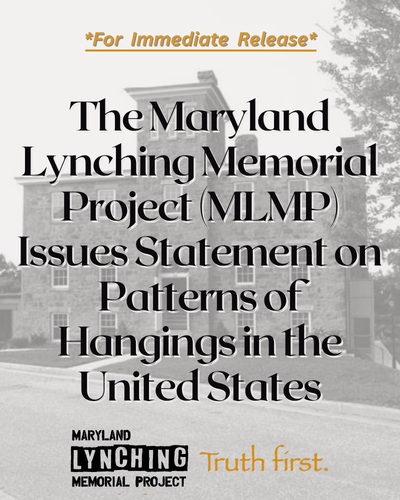
*MEDIA ADVISORY – FOR IMMEDIATE RELEASE*
Contacts:
Amy Millin, MLMP President: amillin@mdlynchingmemorialproject.org
~~~~~~~~~~~~~~~~~~~~~~~~~~~~~~~~~~~~~~~~~~~~~~~~~~~~~~~~~~~~~~
MLMP ISSUES STATEMENT ON PATTERNS OF HANGINGS IN THE UNITED STATES
Baltimore, MD — October 2, 2026 — The Maryland Lynching Memorial Project is deeply troubled by the clear rise in Black people found hanging from trees in communities across the United States. The frequency of these deaths and the similarities they share across jurisdictions reflect an extremely dangerous trend that evokes the trauma and terror of racial terror lynching committed against Black communities. Black residents of these communities are clearly communicating that these deaths create an atmosphere of fear, and that they warrant in-depth and meaningful investigations.
MLMP commends and supports the efforts of the Congressional Coalition led by Rep. Ayanna Pressley. We join them in naming the historical connections that these deaths have, the intergenerational trauma that they trigger, and in demanding a dedicated team staffed by the Department of Justice, the FBI, and other relevant bodies that would focus exclusively on identifying the manner of these deaths and any systemic factors that contributed to them.
Throughout the United States’ history, racial terror lynchings have been used as a tool of white supremacy to oppress and terrorize Black communities across the country. The Equal Justice Initiative has documented nearly 6,500 cases of racial terror lynching between 1865-1950. Thirty-eight of those murders occurred in Maryland. However, racial terror lynchings occured well after this time period, continuing into present day in cases like those of James Byrd, Jr. in 1998 and Freddie Gray in 2015. Between 2000 and 2025, 70 modern-day lynchings were recorded in seven states alone, with study authors citing distinct markers of racially-motivated violence and a lack of attention to the crimes.
As stated in Rep. Pressley’s letter, many past and present lynchings would not have been possible without the involvement of official entities like law enforcement, the courts, the press, and government leadership. While many of these deaths have been ruled as suicides or accidents, there is historical precedent that opposes these findings. There are countless examples of suspicious deaths of Black people being ruled as accidents or suicides regardless of contrary evidence. Two examples from Maryland alone include Keith Warren in 1986 and Kathy Morris in 2012. There is also empirical data that contradicts this preponderance of suicides, particularly by outdoor hanging. According to the CDC, suicide by outdoor hanging is rare across all races, and overall suicide rates have decreased over the past several years. The impact of these suspicious deaths is the evocation of racially-motivated violence perpetuated against Black communities by the American public and its justice system.
Given this history and the clear pattern of escalation, leaving these death investigations in the hands of local law enforcement alone does not serve the interest of justice; nor does it safeguard the physical, mental, and emotional wellbeing of Black communities across the country, living every day with the renewed fear of seeing one of their neighbors meet a similar fate.
In 1892 – the same year that James Taylor was lynched in Kent County, MD – anti-lynching activist Ida B Wells-Barnett told the world that the remedy to the lawless cruelty of lynching was in collective action by an awakened public. She proclaimed that, “Every individual can contribute to this awakening. When a sentiment against lynch law as strong, deep and mighty as that roused against slavery prevails, I have no fear of the result.”
This sentiment holds just as true in 2026 as it did then. We must join the growing public voice demanding justice for these victims and their communities. Whether they met their death at the hands of persons unknown – as was so common with lynching victims of the past – or as a byproduct of the brutal systemic racism that plagues this country, our communities deserve justice. Please join us: write your representatives, share the stories of these victims, and be a voice of truth.
We hold the loved ones of these individuals in our thoughts, and join them and Rep. Pressley’s demands not only for answers, but for true justice for their loved ones. May their memories forever be a blessing, and may the truth of their deaths be brought into the light.
ABOUT THE MARYLAND LYNCHING MEMORIAL PROJECT
Website: https://www.mdlynchingmemorial.org/
The Maryland Lynching Memorial Project (MLMP) seeks to memorialize Maryland’s 38 known victims of racial terror lynching and educate on the roots and causes. Founded in 2017 by Will Schwarz, MLMP has collaborated with national nonprofits like the Equal Justice Initiative and the Maryland State government to bring the dark truth of Maryland’s history of racism and racially-motivated violence into the light. They serve as a fiscal sponsor to over a dozen county-based coalition dedicated to memorializing their own racial terror lynchings.
Through their individual work and the work of their coalitions, MLMP has erected numerous memorial markers, distributed thousands in scholarships and general operating expenses, provided hundreds of educational sessions, and has become the nation’s leader in large-scale racial terror lynching memorialization and education. In 2023, they unveiled a permanent “Lynching in Maryland” exhibit at the Reginald Lewis Museum in Baltimore’s Inner Harbor.
Now led by board president Amy Millin, MLMP works to continue its legacy work, as well as to gain community input on the develop of a statewide memorial marker (please feel free to email Amy Millin or Magpie Editor Emma Buchman for any feedback you have on a statewide memorial).
Learn more about MLMP by attending their 9th Annual Conference on October 24, 2026. Register for your ticket HERE.
~~~~~~~~~~~~~~~~~~~~~~~~~~~~~~~~~~~~~~~~~~~~~~~~~~~~~~~~~~~~~~
Featured Image: The old Baltimore County in Towson, MD, where 15-year-old Howard Cooper was lynched on July 13, 1885.