
By Emma Buchman, Magpie Editor
Emma Buchman is the editor of The Magpie and a writer/researcher at Studio ATAO. She is also a board member of the Maryland Lynching Memorial Project. Emma has studied Chernobyl for over almost seven years, focusing on the history of the accident and its liquidators. For three years, Emma also contributed to a website that collected information on the Chernobyl disaster, specifically sources contemporary to the time of the accident and memoirs from liquidators.
Part 4/11 of “On the Safety of Storks”.
“In this year’s [2006] 20th-anniversary reports on the Chernobyl accident, news outlets variously claimed that the disaster had resulted in 93,500, 70,000, 4,000, hundreds or just 31 human deaths. We couldn’t find a single story that tried to explain the enormous difficulties of determining an accurate number for the excess cancer deaths caused by the radiation fallout from Chernobyl. The press did not attempt to explain the differences in opinions between scientists or the contradictory results of research on animals exposed to radiation.” –Robert Baker & Ronald Chesser, “Growing Up in Chernobyl”.
~~~~~~~~~~~~~~~~~~~~~~~~~~
Introduction
Based on what we’ve learned from the first three parts in this series, there are a few things we know to be true. First, the Chernobyl disaster was the world’s worst nuclear catastrophe that ruined countless lives and left an indelible mark on the modern world.
Second, the Chernobyl Exclusion Zone (CEZ) is a living memorial to this catastrophe. It is among the largest nature reserves in Europe and hosts rare species of animals like white-tailed eagles and black storks. Many different organism communities (including humans) call it home.
Finally, the verdict of the CEZ’s health is about as concrete as graphite moderators. As stated in the Introduction, this series was originally supposed to be a single piece about how wildlife has flourished in Chernobyl without humans to interfere. However, I quickly had to change course as a pattern emerged: for every article boasting Chernobyl as a wildlife haven, there would be another in direct contradiction to it.
The ongoing debate on these perspectives in the scientific community is best articulated in the 2020 paper, “Field effects studies in the Chernobyl Exclusion Zone: Lessons to be learnt”:
“In the aftermath of the accident, wildlife in some areas of the CEZ were exposed to extremely high dose rates with consequent significant detrimental effects being observed in a range of organism types (e.g. Gersk’kin et al., 2008). There is no challenge to such observations; the effects were clear and in line with our established understanding of the effects of radiation.
However, whilst the CEZ has offered the opportunity to conduct studies into the effects of chronic radiation exposure on wildlife there is considerable scientific debate with regard to reported studies conducted in the area… This lack of consensus relates to studies conducted one or more decades after the accident. Because of the topic, radiation effects on wildlife, this lack of scientific consensus can have a high public profile and represents one of radioecology’s key challenges.”
There is no debate on the damages caused by the initial Chernobyl disaster, or the more widespread disaster that its fallout presented in the following years. As stated repeatedly throughout this series, the pain and suffering of the people, animals, and environment of Ukraine, Belarus, and Russia is one of the few certainties of the Chernobyl story that should be honored and respected at every point. Regardless of which side of the argument you’re on, that at least seems to be a consensus.
After lamenting on this confusion to my former boss and amazing colleague Esther Pang, she suggested channeling this frustration into contributing to a potential solution. That is when the single piece became the series, and it has only grown since. In Parts 4 and 5 of this series, we will try to answer the question that inspired the whole thing: what does the Chernobyl Exclusion Zone represent today?
Part 4 begins with some context the current radiation and scientific situations in the CEZ. Then it presents the three possibilities. First, that the Exclusion Zone is a New Eden, a rejuvenative paradise for reviving animal communities that shows the resiliency of nature. Second, that the CEZ is a genetic wasteland, where animals suffer from mutations that end their lines and present severe dangers to the global community. Lastly, that both or neither of these theories are true. The CEZ is merely another truth to be found, another place to research.
While this sounds very straightforward, Part 4 has been “infuriatingly complicated” to write, as science reporter Victoria Gill put it. I’ve debated numerous times how I’m going to split it up (or if I would split it at all). So like many posts on The Magpie, this Part 4 will be a living document updated as frequently as possible with new academic studies to create an increasingly informed opinion on all perspectives. Russia’s war against Ukraine has stagnated a lot of field research, but it is still important to continually check in on new findings.
With that, I want to let you be the judge and form your own opinion before I share my own (which will be published on Valery Legasov’s birthday, September 1).
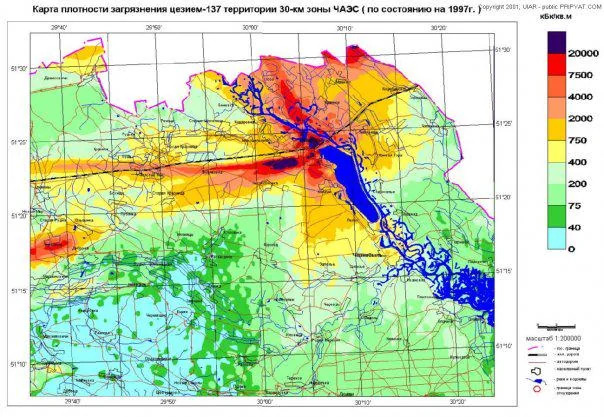
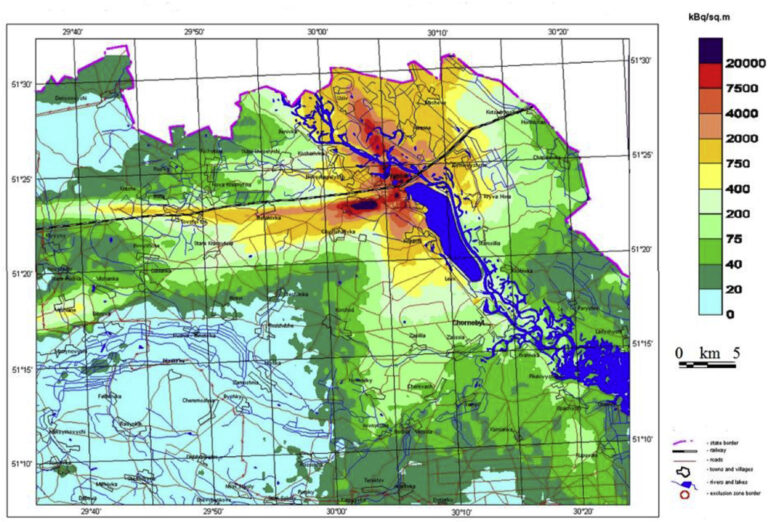
Distribution maps of Cesium-137 and Strontium-90 from 1997. (Credit: Jim Smith.)
Brief Radioecological History
Chernobyl’s fallout was caused by the expulsion of radioactive material from the fourth reactor following two significant explosions. These explosions released around 60% of the reactor’s inventory of Iodine-131, 100% of its Xenon-133, and more than 30% of its Cesium-134 and Cesium-137. Radioecologist Thomas Hinton and his co-authors on a 2007 paper outline three general time periods in Chernobyl’s history of radiation exposure:
- The First 30 days: “an intense exposure period during the first 30 [days] following the accident of 26 April 1986”.
- The First Year: “…a second phase that extended through the first year of exposure during which time the short-lived radionuclides decayed and longer-lived radionuclides were transported to different components of the environment by physical, chemical and biological processes”.
- Legacy: 1987 through the present day, defined by chronic low-dose ionizing radiation leftover from the accident following liquidation efforts; “the third and continuing long-term phase of chronic exposure with dose rates<1% of the initial values”.
The First 30 Days were the most brutal in terms of radiation. Liquidation efforts were few to nonexistent until around 20 hours after the accident. Then it took about a week for the radioactive volcano to be doused. Spanish scientist Germán Orizaola explains that very few animals would have survived the highest radiation levels of this period. One BBC article by Steven Mulvey from 2006 gave two horrifying examples: “Some animals in the worst-hit areas also died or stopped reproducing. Mice embryos simply dissolved, while horses left on an island 6km from the power plant died when their thyroid glands disintegrated.”
And of course, there are the many animals who were “liquidated” to prevent the spread of radiation. They are victims of this tragedy just as much as anybody else.
Animals born in the generations after the accident immediately faced genetic problems: piglets were born with obvious genetic mutations, including having two heads or multiple legs where only one should be. Local farmers complained directly to General Secretary Gorbachev about it when he visited Chernobyl for the first time in February 1989 (almost three years after the disaster). Chernobyl Commission Chairman Boris Shcherbina accompanied him against his doctor’s orders, and suffered a heart attack on the plane back. He survived only because a medical professional was on the plane.
Radiation in the Exclusion Zone today is defined by chronic low-dose radiation. However, some areas of the CEZ are notoriously dangerous hotspots, including the Red Forest and Glyboke Lake. Adam Higgenbotham illustrates this in an article he wrote for Wired in 2011, when he visited the Red Forest with physicist Gennadi Milinevsky: “…On the far side of the clearing, [Milinevsky] knows, the dosimeter will begin to make a sound no one wants to hear: a terrifying snowstorm of screeching white noise, indicating highly toxic levels of gamma radiation some 1,000 times above normal.”
Different Conditionals and Confounding Factors
“The response of biota to Chernobyl irradiation was a complex interaction among radiation dose, dose rate, temporal and spatial variation, varying radiation sensitivities of the different taxons, and indirect effects from other events.” –Thomas Hinton from the University of Georgia et al
The one truest thing I have come to understand about Chernobyl is that it can never be fully understood. It is a place where the truth is turned on its head at the hands of both man and fate. With Chernobyl, anything is possible. It does not help that every individual aspect of the CEZ contains nuances that cannot be ignored.
Here are a few confounding variables to keep in mind:
- Many positive reports of wildlife in the CEZ could be purely anecdotal, rather than supported by scientific investigation.
- Radiation affects different organisms differently, both within the same species and across different species. However, it is widely accepted that mammals are generally the most sensitive to radioactivity.
- The Zone is not uniformly contaminated. The most radioactive areas of the Zone tend to appear along what are known as the North and West Trace – the paths carved out by ionizing radiation as the wind shifted.
- Radiation can be taken in through many means, and all of them have to be considered. As Professors Michael Wood and Nick Bersford explain, “The actual dose an animal receives depends not only on the amount of external radiation they receive, but also on the amount of radioactive material that the animals ingest by eating and drinking in the area.”
- Science. Lots and lots of science. There are so many confounding factors in scientific research in general. In Chernobyl, they flow like radiation out of the open core. There are a lot of factors that scientists consider, many of which some Chernobyl researchers have used to criticize studies from one point of view. Some include:
- Poor dosimetry measurements
- Inappropriate data groupings
- Inappropriate application of different measurement units of radiation.
- Basing conclusions on external doses versus internal doses.
- Is the radiation we’re seeing a result of chronic exposure, or the legacy of the acute high-level radiation organisms received from the accident?
- There are different types of radiation to consider, and each type has different impacts. For example, beta in the trees, gamma in other locations.
Here have been some of my approaches to make this research easier:
- Pay attention to measurements and think critically about them before sharing them. Often they’re correct measurements but the exact thing their measuring is being misnamed. For example, the size of the entire Exclusion Zone versus the size of the Ukrainian Exclusion Zone.
- Ask yourself how your own individuality might influence your opinions. What do “livable” and “safe” mean to me as opposed to what they mean to you? How might our lived experiences color our opinions and create potential prejudice?
- Keep culture in mind, because it is only slightly less important than the radioscience.
- Don’t beat yourself up when you get things wrong. It’s impossible NOT to get things wrong when studying Chernobyl.
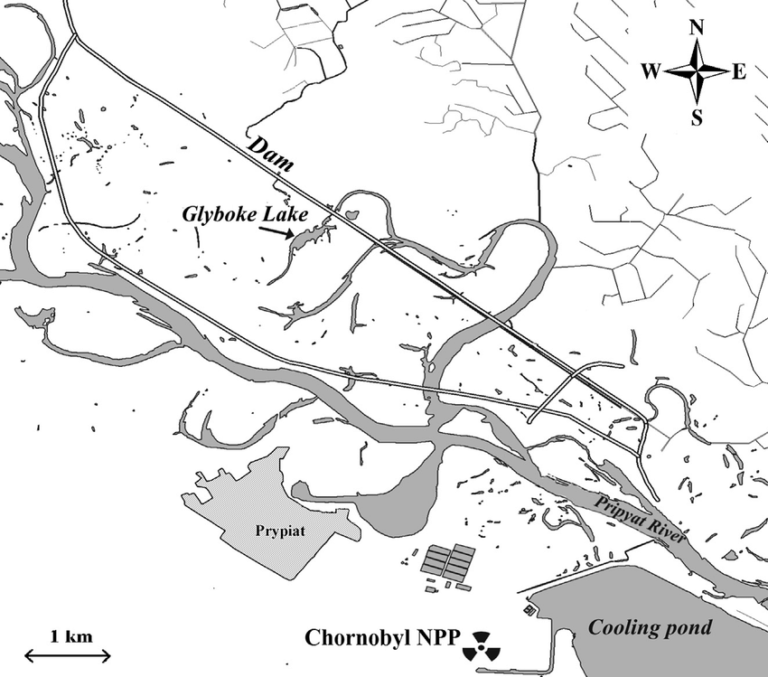
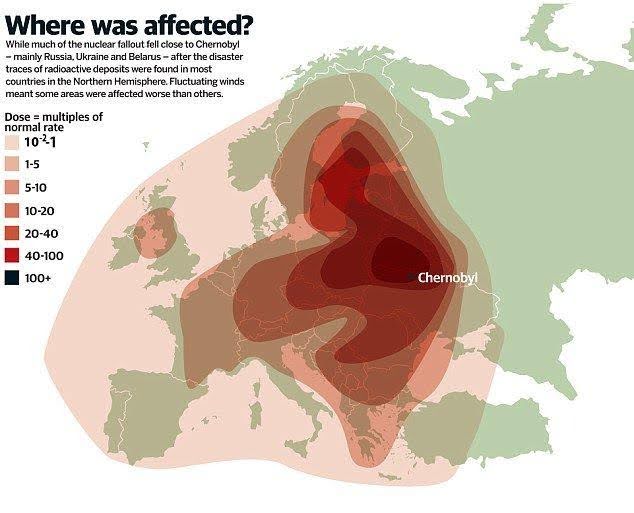
Left: Physicochemical forms of Sr-90 and Cs-137 in components of Glyboke Lake ecosystem in the Chornobyl exclusion zone; u/Stoplizardtrump3 via r/MapPorn. Right: Map of the radiation distribution of the 1986 disaster.
The Human Element
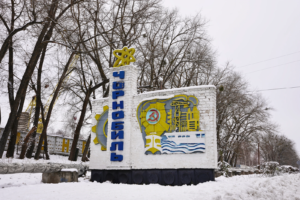
As much as we want to think of science as “strictly business”, in reality it is almost always personal.
Scientific disagreements are nothing new to Chernobyl; in fact, I’d go so far as to say it’s as naturally occurring there as the radiation. I can only imagine the rivalries that plant workers might have had amongst each other, friendly or otherwise.
As far as my own research is concerned, I am most familiar with the rivalry between Academician Valery Legasov, the Chernobyl Commission’s chief scientific advisor, and scientist Eugene Velikov, the specifics of which we’ll go into in a future installment.
In some ways, the rivalries within the study of the health of the Exclusion Zone at least feel less insidious: there’s not one side who is clearly more wrong or right, and if they’re passionate it’s because they care about the health of the Zone. As you go through the research, you’ll notice which scientists gravitate towards a specific side of the argument. You will also find which scientists tend to collaborate with each other… and when they would rather collaborate with literally anyone else.
Much like Chernobyl’s historical scientific rivalries, tensions often overflow. Katarina Zimmer states in her article “Scientists can’t agree about Chernobyl’s impact on wildlife”, “This controversy has only sharpened in recent years”. She recounts one debate that became particularly contentious:
“In 2015, the International Union for Radioecology, a nonprofit group of radiation scientists, invited researchers from both sides to a meeting in Miami, striving to reach a consensus. But the conversation became so heated, ‘they started hurling insults at each other,’ recalls McMaster University radiobiologist Carmel Mothersill, the IUR’s treasurer.”
I don’t raise this point in order to cast my own aspersions or accuse anyone of misconduct or bad science. This is not intended to criticize or accuse anyone of improper research. But interpersonal relationships are deeply embedded in every era of Chernobyl’s history, and it is important to recognize how they impact how the truth is told and who tells it to whom.
Prominent Chernobyl Researchers
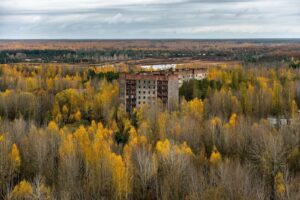
With the above in mind, I would like to recognize today’s Valery Legasovs. I’ve now reviewed dozens of papers by an equal number of scientists, but, there are some names that pop up more frequently than others.
Let me be clear, this list is not exhaustive; these are not the only scientists studying the Chernobyl Exclusion Zone. These are just a few scientists that I’ve seen over and over again in the world of the CEZ, and whose studies made up a good share of my research:
-
- Dr. Robert Baker (1942-2018), Horn Professor of Biological Studies, co-director of the Chernobyl Project, and Director of the Natural Sciences Research Laboratory at Texas Tech University. His work is among the earliest on the CEZ.
- Prof. James Beasley, Terrell Distinguished Professor of Wildlife Management at the University of Georgia and founder of the Beasley Wildlife Lab.
- Prof. Nick Beresford (d. 2023), radioecologist and Group Leader at the UK Centre for Ecology and Hydrology. His research in Chernobyl began in the 1990s.
- Ronald Chesser, PhD, professor of biological sciences and director of the Center for Environmental Radiation Studies at Texas Tech University. His work is among the earliest on the CEZ.
- Prof. David Copplestone, agricultural and biological scientist from the University of Stirling.
- Sergey Gashchak, from the Chornobyl Center for Nuclear Safety, Radioactive Waste and Radioecology. He was a Chernobyl Liquidator and has worked in and studied the Exclusion Zone for over two decades. He also conducted the first survey of birds in Prip’yat in the early 1990s.
- Dr. Martin Hajduch, from the Institute of Plant Genetics and Biotechnology at the Slovak Academy of Sciences.
- Prof. Thomas Hinton, radioecologist and visiting professor at the Institute of Environmental Radioactivity at Fukushima University.
- Gennady Laptev, a Chernobyl liquidator who is now an environmental scientist with the Ukrainian HydroMeteorological Institute. He started work in the zone just three months after the evacuation in late April.
- Heather Meeks, department of biological sciences at Texas Tech University.
- Prof. Gennadi Milinevsky, atmosphere scientist from Taras Shevchenko National University of Kyiv.
- Prof. Anders Møller, Senior Research Scientist at the Université Paris-Saclay.
- Prof. Timothy Mousseau, professor of biological sciences at the University of South Carolina who often works with Møller.
- Prof. Angelina Nyagu, a Chernobyl liquidator specializing in Chernobyl’s health impacts and President of Physicians of Chernobyl.
- Prof. Germán Orizaola, a zoologist at the Universidad de Oviedo in Spain. He studies frogs and amphibians in the Exclusion Zone.
- Dr. Brenda Rodgers (1960-2021), biological sciences professor at Texas Tech University. She specialized in science-diplomacy across continents and began research in Chernobyl in 1998.
- Prof. Jim Smith, Professor of Environmental Science in the School of the Environment, Geography and Geosciences at the University of Portsmouth.
- Prof. Jeffrey Wickliffe, Professor of Environmental Health sciences at the University of Alabama at Birmingham.
- Dr. Michael Wood, Professor of Applied Ecology and Associate Dean Research & Innovation in School of Science, Engineering & Environment at the University of Salford.
- Prof. Sergiy Zibtsev, a professor from the Forestry Institute at the Kiev University of Life Sciences studying the impact of Chernobyl radiation on the Exclusion Zone forests of Scots pine.
These scientists represent a broad range of perspectives, but you should quickly see which side they are on based on their research. Despite their many differences, they seem to agree on a few core truths. However, most of them explicitly state the need for further research to validate their findings (and that they are unable to get funding to do so). Before I leave you with the research, the one pure opinion I want to share is that these scientists deserve funding, and I think we can all agree with that. But that will not happen until global citizens become more vocal in supporting them – those with money and power will not give it to them otherwise. The global public must show more concern.
With all of this in mind… enjoy the descent into madness.
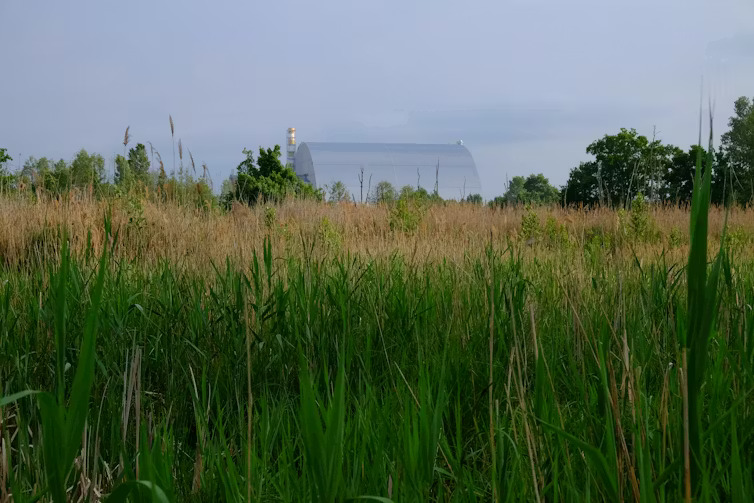
A view of the New Safe Confinement from Lake Azbuchyn in 2019. On February 14, 2025, a drone pierced the Confinement’s shell, compromising its stability. (Photo by Germán Orizaola).
Nature’s Gift…
A consistent explanation from proponents of this philosophy is that wildlife was able to flourish because of a lack of human activity, including hunting, fishing, and ranching. While the chronic low-dose radiation is always present, nature has shown incredible adaptability in evolving to survive and thrive in even severely irradiated environments. Therefore, it should not serve as a deterrent to the CEZ’s development as a nature reserve and living laboratory.
Neutral
These are studies where the conclusion does not contribute to one side of the other. They fit into one or more of the following conditions: (1) no impacts were reported one way or the other; (2) they present findings from both sides of the argument that neutralize each other; (3) they accept both sides of the argument as the truth; or (4) the study discusses the health of the CEZ, but the intent of the research was not to show health impacts.
…or Mankind’s Curse?
Proponents on this side of the argument emphasize that chronic low-dose radiation continues to cause genetic mutations and population decreases in the CEZ today. They view these mutations and other radiation effects as outweighing the benefits of the CEZ’s seclusion from humans, and tend not to support creating new wildlife communities within the CEZ. They also propose that population increases are a result of anecdotal evidence, not scientific research.